
Reading the Verdicts
This page walks through every verdict the wire check produces — a clean wire, a red failure, and a yellow warning — plus how it handles branches, junctions, and cleared fields. If you haven't yet, read The Wire Check for the one-paragraph version.
A valid wire has no special colour
The check only paints problems. A connection that type-checks is left exactly as Node-RED draws it — a solid grey wire — so "no colour" is the all-clear. There is no green wire; only red (failure) and yellow (unverifiable) are painted.
How a wire contract is made
Three tiny nodes carry the whole page. Each declares only what it reads (its input Port<T>) and what it adds (its output Port<T>):
// a shared data type
interface Order { id: string; total: number }
interface Customer { id: string; name: string }

// SOURCE — no input; ADDS `order`
class Source extends IONode<never, never, never,
  Outputs<{ out: Port<{ order: Order }> }>> {}

// ENRICH — READS `order`; ADDS `customer`
class Enrich extends IONode<never, never,
  Input<Port<{ order: Order }>>,
  Outputs<{ out: Port<{ customer: Customer }> }>> {}

// INVOICE — a sink that READS `order` AND `customer`
class Invoice extends IONode<never, never,
  Input<Port<{ order: Order; customer: Customer }>>, never> {}
The message is one accumulating record: each node merges its adds onto what arrived, so a field added early keeps flowing. Enrich never mentions order on its output — the framework carries it through. A wire passes when the record arriving at the target holds every field the target reads, with a matching shape. (See The Message Model for the record itself.)
A connection that type-checks
Source ──▶ Enrich ──▶ Invoice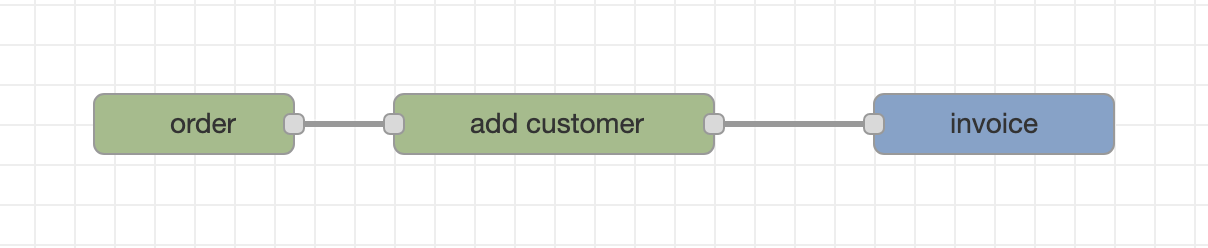
Invoice reads order and customer. By the time the record reaches it, order was added by Source (two hops back, carried through Enrich) and customer by Enrich. Both present, both the right shape → every wire type-checks, so every wire is left its plain solid grey.
Red — a missing field
Drop Enrich and wire Source straight into Invoice:
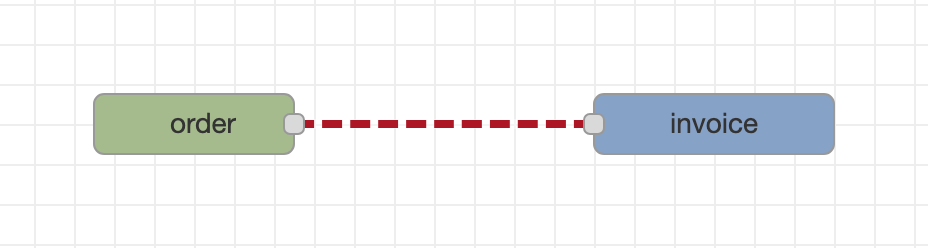
Nothing adds customer, so the connection reds. The log names the exact reader and the missing field:
✖ order[out] -> invoice
    Property 'customer' is missing in type '{ order: { id: string; total: number } }'
    but required in type '{ order: { id: string; total: number }; customer: { id: string; name: string } }'.
Red — a wrong-type field
A same-named field with the wrong shape is caught too. Here a source adds order as a plain string, wired into a node that reads order as an Order:
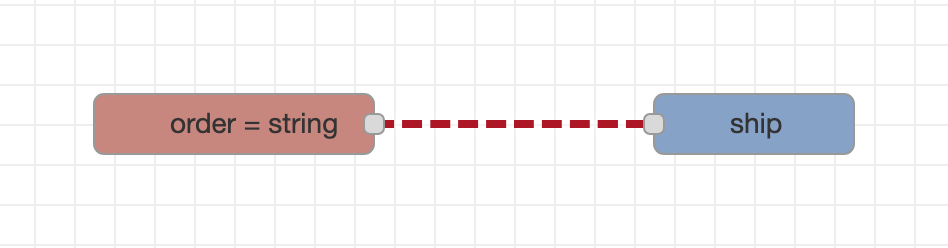
✖ order = string[out] -> ship
    Types of property 'order' are incompatible.
    Type 'string' is not assignable to type '{ id: string; total: number }'.
Yellow — an unverifiable boundary
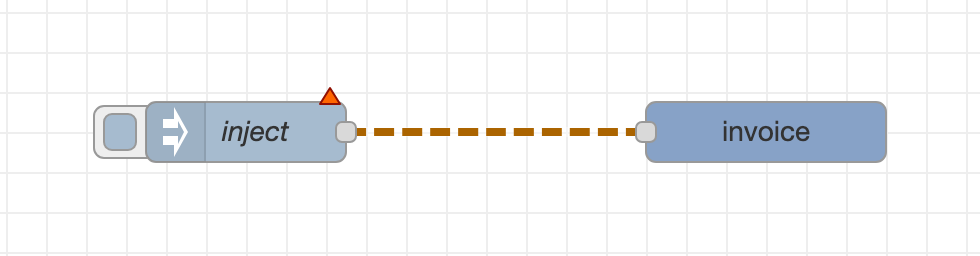
A yellow-dashed wire is not a failure — it's a connection the checker can't fully verify because one endpoint is untyped. The wire stays valid; the caveat is just made visible.
Two things cause it. An nrg node with an untyped output (Port<any> / Port<unknown>) feeding a typed reader:
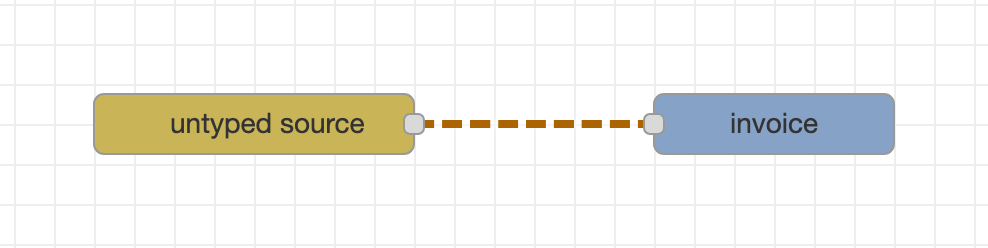
⚠ untyped source[out] -> invoice
    'untyped source' is an untyped output — the message it sends can't be checked
    against what 'invoice' reads.
…and any wire touching a core / non-nrg node (an inject, a function, a third-party node), which has no nrg types at all — so it's a boundary in either direction:
The one exception
A reader whose input is Port<any> / Port<unknown> is a deliberate accept-all passthrough — a wire into it never warns, whatever the source.
"Adds nothing" is Port<{}>, not Port<any> — and not never
A node that only observes and forwards declares its output Port<{}> (adds nothing): it stays green, forwarding the record unchanged with everything downstream still fully checked. Port<any> means "adds something unknown" and yellows here, and never removes the output port entirely (a sink). See port topology.
Branches
Fan-out — one output, many wires
A source's output can feed several targets. Each wire is checked independently against its own target, so one fork can pass while another fails:
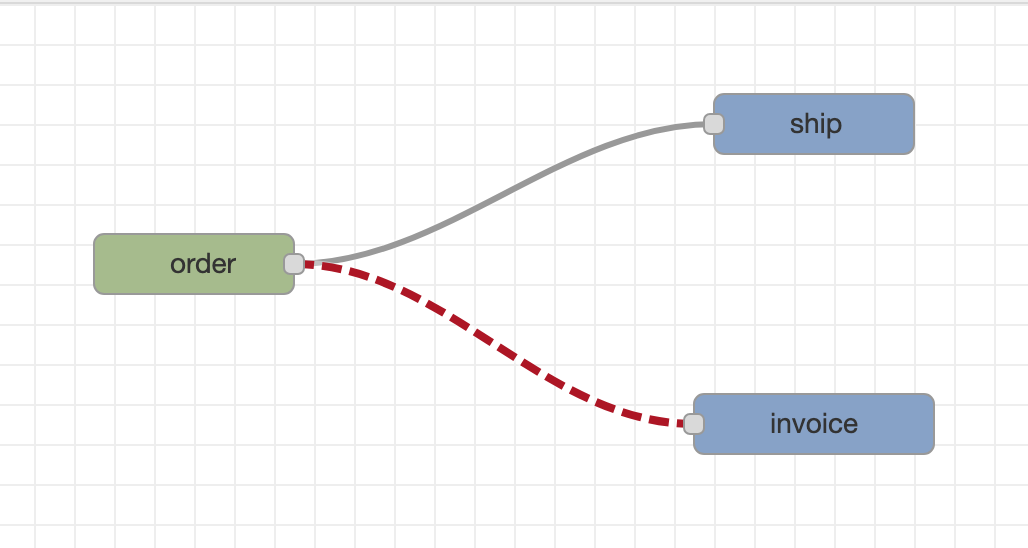
order reaches both. ship (reads order) passes; invoice (also needs customer) fails — on the very same fork.
Fan-in — many wires, one reader
Node-RED delivers each incoming message separately — a fan-in node fires once per arriving message, never a merge of them. So each incoming wire is checked on its own against what the reader needs: one connection, one verdict. All three can land on the same node at once:
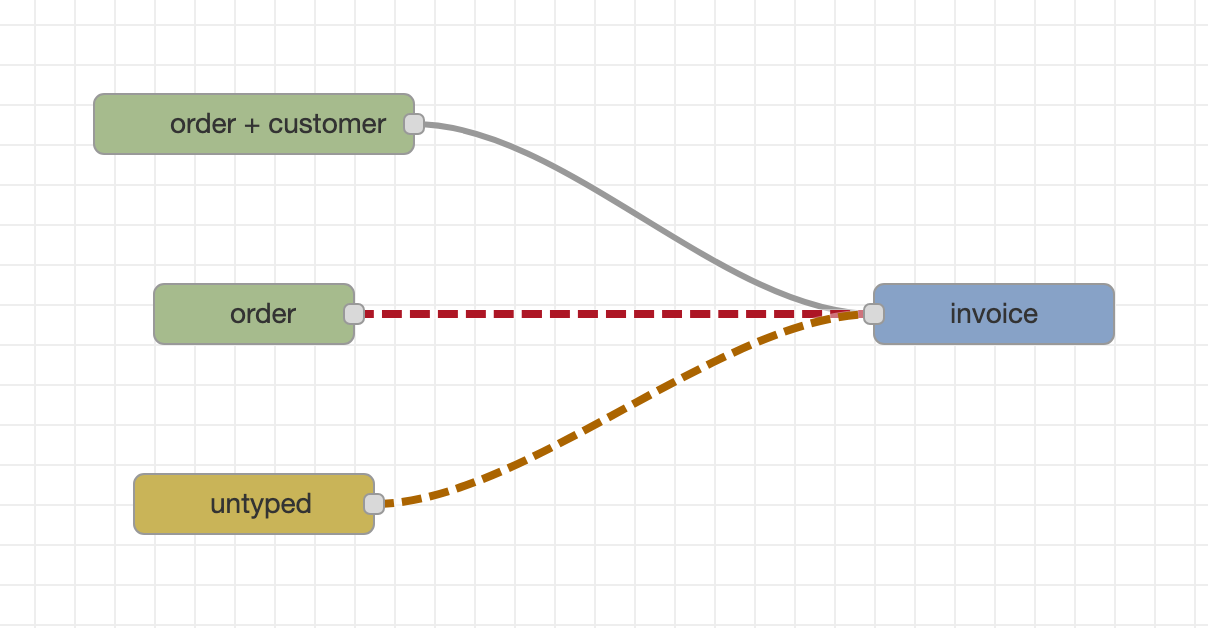
Into the same invoice: the order + customer arm carries everything it reads (solid grey — valid), the order-only arm is missing customer (red), and the untyped arm can't be checked at all (yellow). Downstream of a join, only fields present on every arm are guaranteed — the conservative, sound shape.
Junctions
A Node-RED junction lets you branch tidily: one wire in, then the junction fans the message — unchanged — out to several targets. The checker treats it as a transparent pass-through: it splices the junction out and checks each real endpoint through it.
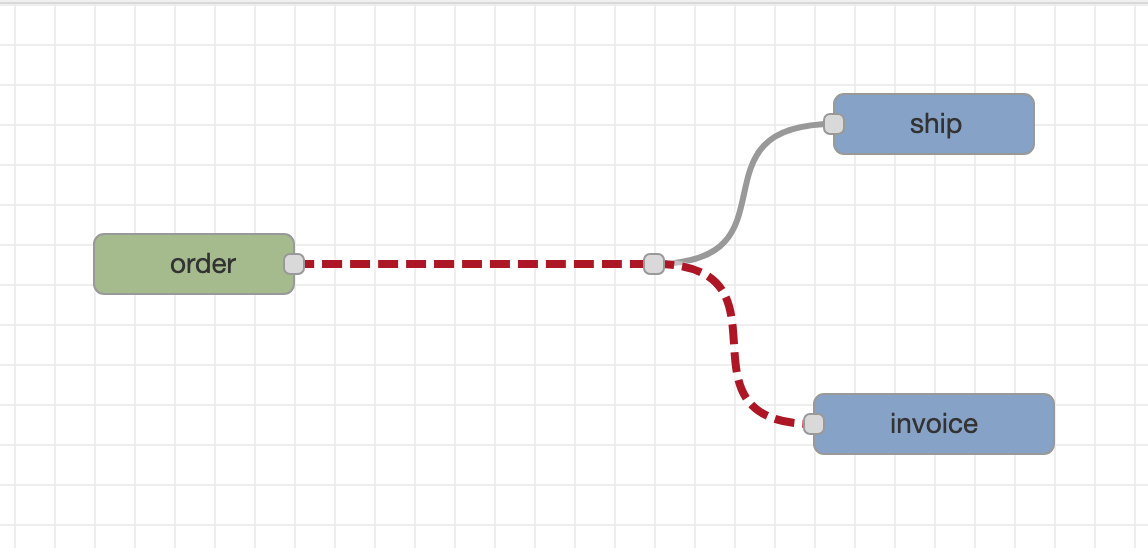
order reaches both branches through the junction. ship (reads order) passes; invoice (also needs customer) fails. And the wire into the junction reds too — a path running through it fails, and the check paints whole paths, not single hops. A junction never hides a type error, and never counts as an untyped boundary.
Removing a property
There's no structural delete on the wire; the supported "remove" is to send a field as undefined, typed Port<{ field: undefined }>:
// CLEAR — READS `customer`, then blanks it
class Clear extends IONode<never, never,
  Input<Port<{ customer: Customer }>>,
  Outputs<{ out: Port<{ customer: undefined }> }>> {}
Whether that reds depends on the reader. A reader that requires the field reds — clearing took away what it needs:

✖ clear customer[out] -> invoice
    Types of property 'customer' are incompatible.
    Type 'undefined' is not assignable to type '{ id: string; name: string }'.
A reader that treats the field as optional (customer?) stays valid — its wire untouched — because an absent value is fine for it:

This mirrors runtime exactly: the record merges ({ ...incoming, ...additions }), so at runtime customer becomes undefined, not deleted — readers should test the value, not key-presence. See The Message Model.